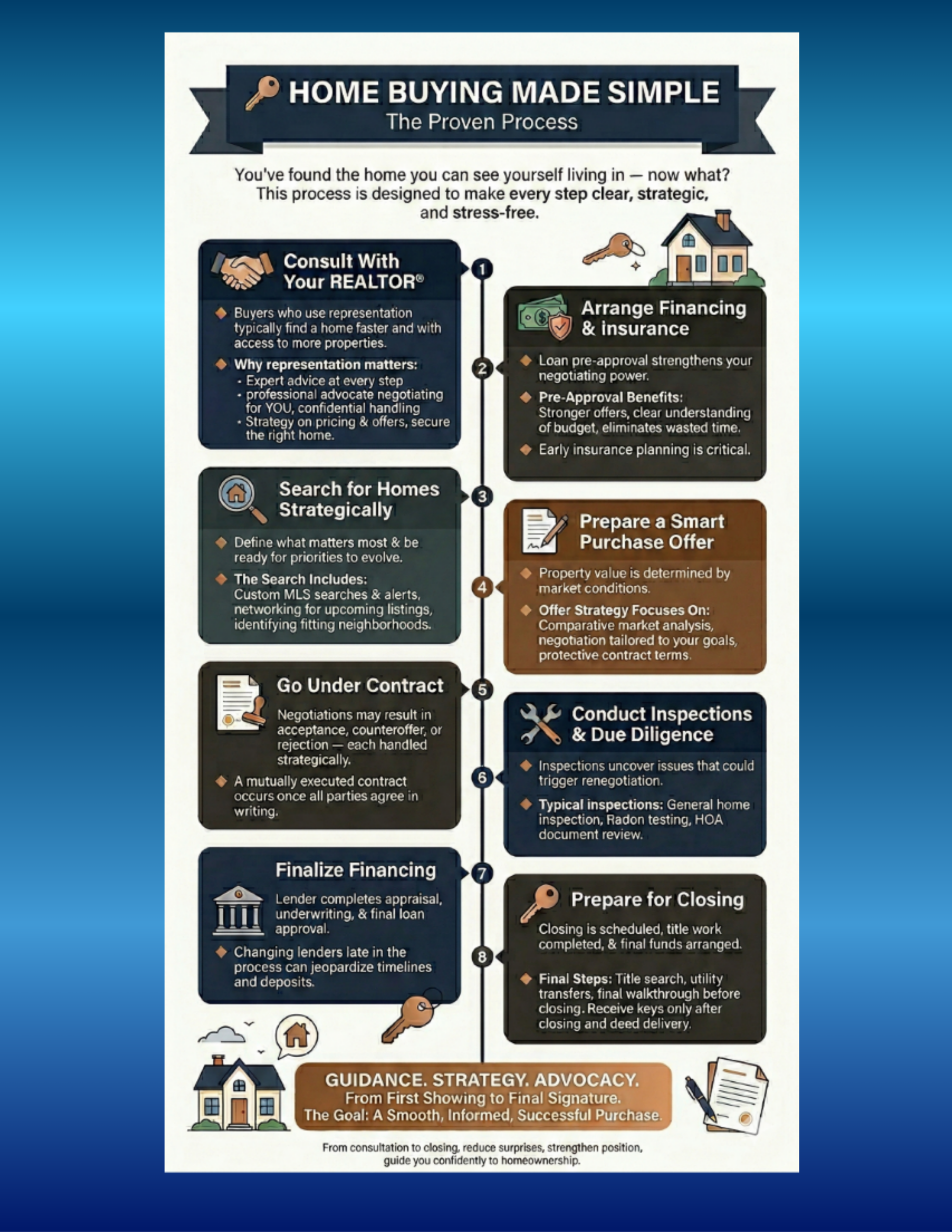
Buying A Home In Grand Junction: Our Process
Thinking about buying a home in Grand Junction? Knowing what to expect can make the entire process feel a lot less overwhelming.
From getting prepared and finding the right home to writing an offer, inspections, financing and closing, I’ll walk you through each step of the Colorado home-buying process.
We cover things like:
- How offers are crafted and negotiated
- Inspections & contingencies (with hard deadlines)
- Financing, appraisal, and lender coordination
- Title insurance, closing costs, and preparations
- Final walkthrough and settlement day logistics
The steps are comprehensive and follow Colorado’s standard real estate contract rules to protect you every step of the way.
Don’t worry if it feels like a lot—I’ll make sure each part stays simple and clear for you. I’m always available—feel free to call me anytime for more details, explanations, or just to talk through whatever’s on your mind.
Excited for you! Let’s get this home yours.
Our Buying Process
You’ve found the home you can see yourself living in—now what?
There’s a ton of detailed information available here covering every part of the home-buying process in Colorado—from writing and negotiating your offer, through due diligence (inspections, radon, HOA docs), financing steps, title work, final walk-through, and all the way to closing day.
We cover things like:
- How offers are crafted and negotiated
- Inspections & contingencies (with hard deadlines)
- Financing, appraisal, and lender coordination
- Title insurance, closing costs, and preparations
- Final walkthrough and settlement day logistics
The steps are comprehensive and follow Colorado’s standard real estate contract rules to protect you every step of the way.
Don’t worry if it feels like a lot—I’ll make sure each part stays simple and clear for you. I’m always available—feel free to call me anytime for more details, explanations, or just to talk through whatever’s on your mind.
Excited for you! Let’s get this home yours.
STEP ONE : Consult with your Realtor
Why Most Home Buyers Choose a Realtor® to Represent Them
The vast majority of home buyers decide to work with a Realtor® who represents their interests during the home buying process.
According to the National Association of REALTORS®, 88% of buyers purchased their home through a real estate agent or broker. Buyers most often turn to agents for help finding the right home, negotiating terms, understanding the market, and navigating the paperwork.
My clients choose me, Kate Porras, as their Buyer’s Representative because they want:
- My experienced advice and judgment at every step of the process.
- A professional advocate who puts their interests first—not the seller’s or anyone else’s.
- Their personal information and discussions kept completely confidential from other parties.
- Smart strategies for pricing, crafting strong offers, negotiating effectively, handling repairs, and using the right contingencies.
- To secure the home they love at the best possible price—and in the shortest amount of time.
To represent you as effectively as possible, a great Buyer’s Agent should:
- Have deep knowledge of how real estate transactions actually work.
- Understand the local market and neighborhoods inside and out.
- Be a skilled and confident negotiator.
- Be readily available and responsive when you need them.
- Spot potential problems before they become big issues.
- Excel at solving problems quickly and creatively.
- Work efficiently while staying focused on results.
- Communicate clearly and collaborate well with other agents.
- Be detail-oriented, highly organized, and follow through on everything.
- Deliver outstanding service and truly prioritize your needs.
Working with the right Buyer’s Agent—like me—helps make the process smoother, smarter, and more successful for you. Let’s chat about how I can support your home search!
STEP TWO : Research and arrange your financing and insurance
THE LOAN PRE-APPROVAL LETTER
Here’s a clearer, easier-to-read rewrite of the information, tailored for home buyers working with Kate Porras. I’ve used simple language, short paragraphs, bullet points, and bold headings to make it scannable and practical.
Get Pre-Approved: Your Secret Weapon in Today’s Market
A strong written pre-approval letter from a mortgage lender gives you real leverage. It helps you negotiate the best price and terms—especially in competitive situations where multiple buyers are interested.
Pre-Approval vs. Pre-Qualification – Know the Difference
– Pre-Approval → You’ve submitted a full written loan application with verified documents (income, assets, credit, etc.). The lender has reviewed and conditionally approved you for a specific loan amount. This is serious commitment from the lender.
– Pre-Qualification → Just a casual conversation or quick estimate based on what you tell the lender. Nothing is verified—no credit pull, no documents checked, and no real commitment.
Pre-approval is what sellers and agents take seriously.
Key Benefits of Getting Pre-Approved
– You stand out as a serious, ready-to-act buyer—giving you a big edge over others who aren’t prepared.
– Stronger negotiating power: Sellers trust you’re likely to close.
– Saves time, reduces stress, and avoids heartbreak—no wasting time on homes you can’t afford.
– Most verifications and contingencies are already handled (except appraisal and the final contract).
– Simply find the home you love, then submit your offer with confidence.
– You know your exact monthly payment upfront.
– You know precisely how much cash you’ll need at closing.
Important Note on Affordability
What the lender says you qualify for and what you’re comfortable paying each month can be very different. You might get approved for a higher payment than feels right for your budget. Always discuss this openly with your lender—and with me, your Realtor®—so we target homes that fit your lifestyle, not just the max approval.
My Personal Recommendations for Financing
Work with a trusted lender early. Get pre-approved before house hunting—it positions you to move fast when you find “the one.”
What You’ll Need for Pre-Approval
Lenders typically ask for these documents (the list looks long, but most are easy to gather—your lender will guide you):
– Employment info: Current employer name, address, phone; most recent pay stub.
– Previous jobs: If less than 2 years at current job, details on prior employer.
– Other income: Alimony, child support, disability, Social Security, VA benefits, rental income (with proof).
– Credit authorization: Permission to pull your credit report.
– Current debts/mortgages: Account details, payments, balances (including any recent payoffs; lease/sale docs if renting/selling property).
– Credit cards & loans: Account numbers, balances, payments (including auto, student, personal loans).
– Other obligations: Alimony, child support, etc.
– Self-employed/business owners (25%+ ownership): Year-to-date profit/loss, past 2 years’ personal/business tax returns, 1099s.
– Tax returns: Past 2 years if using overtime, commissions, bonuses, or tips for qualification.
Your lender will walk you through collecting these—many are quick grabs from online accounts or old files.
What Happens After Approval? The Commitment Letter
Once underwritten and approved, you get a commitment letter. Final funding usually depends on:
– Appraisal
– Survey (not always required)
– Title search
Additional Info for the Full Loan Application (After You Have a Contract)
– Signed purchase contract + addenda, deposit check copy, property data sheet.
– Past 2 years’ W-2s.
– Bank statements (checking/savings—at least 3 months).
– Other assets (stocks, bonds, life insurance cash value, retirement accounts, etc.).
– Landlord info (if renting now).
– Photo ID (driver’s license copy).
– VA buyers: Certificate of Eligibility, DD-214, etc.
Extra Costs to Budget For (Beyond the Loan Amount)
Before Closing
– Earnest money deposit: Typically 1-3% of purchase price (sometimes more in hot markets; this shows good faith and is credited toward closing).
– Home inspection.
– Appraisal fee.
– Survey (if needed).
At Closing
– Down payment.
– Lender fees.
– HOA dues (if applicable).
– Homeowners insurance premium.
– Recording fees.
Some of these (like closing costs) can sometimes be negotiated for the seller to cover.
Don’t Wait on Homeowners Insurance – Start Early!
Getting hazard/homeowners insurance used to be quick, but now it often takes days or weeks. Insurers check the property’s claims history and your personal claims history.
Start this process right away—even before we find your dream home. It’s as critical as getting pre-approved.
– Call your current insurance agent or broker today.
– If you need recommendations, I’m happy to share trusted local options.
– Your lender requires hazard insurance (covers damage/destruction) with them named as co-insured.
– Most buyers get full homeowners insurance (hazard + liability + personal belongings coverage).
– A policy binder (proof of coverage) must be in place before closing, and evidence sent to the lender.
For Condo Buyers
The building’s master policy (paid via HOA fees) covers the structure for you and the lender—but not your personal liability, contents, or damage from your unit to others. Get separate coverage for your belongings and extra protection. Talk to your agent about what’s right for you.
Getting pre-approved and starting insurance early makes the whole process smoother and stronger. Let’s discuss your financing next steps—I’m here to help every step of the way!
STEP THREE : Search for Homes
Finding The RIGHT Home in Grand Junction!
This is where the excitement really begins—touring homes, imagining your life in new spaces, and narrowing down what feels right. House hunting should feel like an adventure, not a chore!
Ready to see what’s available? View Kate’s current Grand Junction home for sale.
Be Clear About What You’re Looking For
The more specific you are with me, the faster and smarter we can search. Tell me:
– Your absolute must-haves (non-negotiables—like number of bedrooms, school district, no stairs, fenced yard, etc.).
– Your big “why” behind each priority (e.g., “We need a home office because I work remotely and need quiet space” or “Proximity to trails is key for our family’s hiking lifestyle”).
– What you’re flexible on.
Sharing your “why” lets me spot great alternatives if your ideal home isn’t available right away. Clear priorities save everyone time and keep us focused on homes that truly fit your life.
Your Priorities Might Shift—That’s Normal (and Okay!)
As we tour homes together, things can change:
– A “need” might become a “want” once you see real options.
– A “want” might turn into a “must-have” after experiencing it.
Your initial wish list is just a starting point. If your feelings evolve, just tell me—I’ll adjust our search strategy immediately to match what matters most now.
How I Help You Find the Right Home
I use every tool and connection to give you an edge in the Grand Junction market (where inventory is improving and more balanced conditions in 2026 mean better opportunities for buyers):
– Multiple Listing Service (MLS): I set up custom daily/weekly reports tailored exactly to your criteria and alert you to new matches right away.
– Upcoming Listings: I network constantly with other agents to learn about homes hitting the market soon—giving my clients first look before they go public.
– For Sale By Owner (FSBO) Properties: I watch for these hidden gems and regularly check with my network and mailing list for off-market opportunities in your preferred neighborhoods.
Get to Know the Neighborhoods
We’ll explore areas together to:
– Discover what appeals most (schools, parks, commute, vibe, amenities).
– Rule out spots that don’t fit.
– Build your local knowledge so your search gets sharper and more targeted over time.
Touring Homes: Love It or Like It a Lot?
As we view properties, keep these questions in mind:
– Do you absolutely love it, or is like it a lot good enough? (Most buyers choose homes that suit their current life stage and plan to move again in the future.)
– Identify a fallback home—knowing there’s a solid backup can reduce pressure and give you leverage in negotiations.
– Ask yourself: Would I be disappointed if this sold tomorrow to someone else? If yes, it’s time to talk offers—let me know when you’re ready!
What If We Don’t Find “The One” Right Away? Don’t Worry—We Adapt!
If perfect matches are slow to appear (common in our market with ongoing affordability factors), we have options:
– Tweak criteria — Sometimes looking at homes you didn’t think you’d want opens surprising doors.
– Adjust price range — Exploring slightly higher (with smart financing) or different loan options can unlock better homes.
– Consider property type — Detached single-family, townhome, or condo? Switching types while staying in your area/price can meet core needs.
– Reevaluate size — Could you skip the extra bedroom, big garage, or bonus room if the rest is spot-on?
– Explore locations — Trade a bit of location for more house, or vice versa. I can show you where your priorities align best in Grand Junction and nearby areas.
New listings come on constantly—hang in there! We’ll revisit and refine together until it clicks.
When We Find the Right Home, I’ve Got You Covered
Once we spot “the one,” I handle everything to protect your interests:
– Craft a smart offer strategy.
– Run a comparative market analysis (CMA) to confirm if the price is fair.
– Help set your target offer price.
– Prepare and submit a strong purchase offer focused on your best outcome.
– Negotiate terms aggressively on your behalf.
– Coordinate with your lender to keep financing on track.
– Schedule and oversee inspections, then address any issues that come up.
– Manage all paperwork through to a smooth closing.
– Assist with selling your current home if needed.
– Follow up post-closing to ensure you’re thrilled.
– Stay available long-term for any questions.
This phase is all about discovery and joy—let’s make it fun and find a home that feels like you. Share your must-haves, your “why,” and any dream features. I’m ready when you are—let’s start touring! 🏡
STEP FOUR : Prepare a Purchase Offer
Determining a Home’s True Value
Property value isn’t an exact science—it’s shaped by what buyers and sellers agree on in the current market. I prepare a detailed comparative market analysis (CMA) that gives you a realistic value range based on recent comparable sales, active listings, and broader trends.
Key terms to know:
- List Price — The seller’s asking price (best set with input from a real estate professional).
- Market Value — The most likely price in an open, competitive market with reasonable time to sell.
- Sale Price — The final negotiated price, decided by what a ready buyer and motivated seller agree to.
How I Help You Assess Value & Choose Your Offer Price
I analyze:
- Recent sold comps (similar homes that actually closed).
- Current active listings and market trends (like days on market, inventory supply, and local shifts).
- Any unique factors affecting the property or neighborhood.
This gives us a solid foundation to pick a target offer price that’s competitive yet protects your interests—no guesswork.
Your Negotiating Position – Build Strength Where You Can
Your leverage depends on your situation and the market at the moment. You’re often in a strong position if:
- You have no home to sell (or it’s already under contract).
- You’re fully pre-approved for financing (pre-approval letter ready) or paying cash.
- Your offer is “clean” — minimal contingencies, reasonable timelines, meaningful earnest money.
A prepared, straightforward offer shows sellers you’re serious and likely to close smoothly—which can make a big difference. In slower or more balanced markets, this might let you negotiate below list price. In competitive ones, meeting or exceeding list could be needed to win. My approach: Tailor a strategy that maximizes your offer’s success based on current realities.
Define Your Priorities Before We Negotiate
Rank what’s most important so we can trade effectively:
- Price
- The home/property features
- Closing/settlement date
- Other terms (like repairs, inclusions, or contingencies)
This clarity helps us give the seller what they value in exchange for concessions that matter to you.
Extra Ways to Make Your Offer Stand Out
- Higher earnest money deposit — Demonstrates commitment.
- Flexible or quick closing/occupancy — Aligns with the seller’s timeline.
- Attach your pre-approval letter — Builds confidence in your financing.
- Limit or accelerate contingencies — Reduces seller risk (while keeping protections you need).
- Professional, polished presentation — I handle the details for maximum impact.
The 7 Main Areas We Negotiate
We aim for the best overall terms: Get the home you want while making the offer appealing to the seller. I often gather insights from the listing agent about the seller’s needs—meeting those can open doors for your requests.
- Offering Price — Typically the seller’s top priority. We use the CMA to find the right number.
- Seller Concessions/Subsidies — Asking the seller to cover closing costs? It affects their net proceeds and price flexibility (loan guidelines may cap amounts—confirm with your lender).
- Earnest Money — A stronger deposit increases seller trust and offer appeal.
- Settlement & Occupancy — Matching the seller’s preferred dates strengthens your position.
- Property Condition/Repairs — Request known fixes upfront, or address post-inspection findings.
- Inclusions & Exclusions — Clearly specify what’s included (appliances, fixtures) or excluded to prevent surprises.
- Contingencies — Standard ones cover financing, inspection, or your home sale. Fewer contingencies = stronger offer; we keep only essentials.
Show Proof You’re Ready
Boost credibility by including:
- Pre-approval or commitment letter — Helps remove or shorten financing contingency.
- Bank statements (for cash offers) — Proves funds are available.
- Financing details — If full commitment is pending.
Crafting & Presenting Your Offer
We discuss your goals, budget, and any questions first. Then I draft a clear, professional purchase agreement. You review/sign—and I deliver it quickly to the seller’s agent.
In Competitive Scenarios
If multiple offers come in, the path to winning might mean full price (or above) plus “giving the seller everything” (quick close, high earnest, few contingencies). It’s a trade-off—I provide the data, pros/cons, and local insights so you decide what’s best.
Markets fluctuate, but solid preparation, accurate valuation, and a tailored strategy always give buyers the edge. When you’re ready to make an offer on a home, let’s run a fresh CMA and build your plan. I’m here to guide you every step! 🏡
STEP FIVE : Contract for Your Home
Writing & Negotiating Your Offer: The Key Steps
This is the moment where strategy meets action—crafting an offer that positions you to win the home you want at terms that work for you. In Colorado, we use the Commission-approved Contract to Buy and Sell Real Estate (Residential) form (updated for 2026), which is detailed, deadline-driven, and legally binding once fully executed. Time is of the essence in every deadline, so quick responses and clear communication are crucial.
Approaches to Negotiation: Finding the Right Balance
Buyers and sellers have different risk tolerances. We can discuss these styles when it’s time to write your offer:
- Extreme offers (very low price or aggressive terms) often trigger strong pushback, stall talks, or offend the seller—making future compromise harder.
- Fair initial offers build trust, encourage reasonable dialogue, and lead to smoother, mutually beneficial deals more often.
A good rule: Put yourself in the seller’s shoes. Ask, “If I received this offer on my home, how would I react?” If it’s likely to feel insulting or off-putting, we adjust to keep negotiations positive and productive.
The Negotiation Process: Step by Step
- Submitting Your Initial Offer
- Offers are typically delivered electronically to the seller’s agent (in-person presentations are rare today).
- Personal letters (sometimes called “love letters”) from buyer to seller: We can discuss if this fits your situation, but be aware of risks under federal Fair Housing laws (and Colorado’s alignment with them). Letters revealing details about protected classes—race, color, religion, sex, national origin, familial status (e.g., having children), disability—could unintentionally expose the seller (or agents) to discrimination claims if the seller’s decision appears influenced by that info. Many experts (including Colorado real estate professionals) recommend avoiding them to minimize legal risk. Focus on strong financial terms instead.
- Questions from the Seller/Seller’s Agent
- Expect quick follow-ups via me (phone/email) before any acceptance or counter. Stay reachable—fast answers help move things forward.
- Possible Outcomes
- Acceptance — Signed as-is; congratulations, you have a deal!
- Counteroffer — Seller proposes changes; we review and respond promptly.
- Rejection — Seller declines to negotiate (offer returned marked “Rejected”).
- No Response — Offer expires at the stated Acceptance Deadline (date/time in the contract).
Responding to Counteroffers
Act fast—delays can lead to the seller changing their mind or accepting another offer. We’ll strategize your reply to keep momentum while protecting your priorities.
Mutually Executed Contract (MEC) – When It’s Official
A Mutually Executed Contract (MEC) exists when:
- All parties have agreed in writing to every term (no additions/amendments pending).
- A fully signed copy is delivered to the other party.
MEC starts most deadlines (e.g., inspection, appraisal). Until then, the offer isn’t binding—either side can walk away.
When There Are Multiple Offers
- Sellers aren’t required to disclose competing offers (though they may choose to).
- Typically, the seller accepts or counters only one at a time.
- In some cases, the seller may request “best and final” offers from all buyers (no counters issued yet).
Your pre-approval, clean terms, and strong earnest money make your offer stand out—especially in any market.
My Role in This Phase
I’ll:
- Guide you on strategy based on the CMA, market conditions, and seller priorities.
- Draft a professional, compliant offer using the official Colorado form.
- Present it promptly and handle all communications.
- Negotiate counters aggressively to get you the best possible terms.
- Ensure you understand every deadline and obligation (these contracts are strict!).
Colorado law emphasizes clear, written agreements and fair practices—I’m here to keep everything compliant and focused on your success. When we spot a home you love, let’s craft an offer that gives you the edge. Ready to discuss your approach? Just say the word!
STEP SIX : Conduct Inspections
Inspections & Due Diligence: Protecting Your Investment
After your offer is accepted and you have a Mutually Executed Contract (MEC) in Colorado, the real due diligence begins. This phase lets you thoroughly check the home’s condition and any community rules before you’re fully committed. Colorado’s standard Residential Contract to Buy and Sell Real Estate (Commission-approved form) includes specific contingencies for inspections, objections, and resolutions—with hard deadlines that are strictly enforced. Missing them can waive your rights or risk your earnest money.
Whether to include inspections depends on the property, current market conditions, and your comfort level. Most buyers include at least a general home inspection and often radon testing (especially relevant in Colorado, where elevated levels are common).
General Home Inspection
- Schedule it early—ideally right after the contract is executed—to allow time for follow-ups or specialist inspections.
- The inspector (typically 2–3 hours) will walk you through findings. It’s educational: You’ll learn about the home’s systems, potential issues, and maintenance needs.
- Purpose: Uncover significant defects that could lead to renegotiating terms (repairs, credits, price adjustments) or, in serious cases, terminating the contract.
- If issues arise, respond thoughtfully: Clearly state your requests in the Inspection Objection Notice (a written form). This might mean asking the seller to fix items, provide credits, or adjust price—but only if you’re willing to proceed if they agree.
- Deadlines are hard: The Inspection Objection Deadline (when you must deliver written objections) and related resolution/termination dates are non-negotiable. We’ll track them closely together—consult me at every step to stay on schedule.
Radon Testing
- Colorado law (Senate Bill 23-206, effective 2023) requires specific radon disclosures in every residential sales contract:
- A bold warning recommending all buyers test for indoor radon before purchase and mitigate if elevated levels are found.
- Seller must disclose any known radon test results, reports, mitigation history, or installed systems.
- A CDPHE radon brochure is provided.
- Radon is a colorless, odorless gas—the leading cause of lung cancer in non-smokers. Colorado has higher-than-average levels (about half of homes test above the EPA action level).
- Testing: Often done by your home inspector or a licensed radon measurement professional (required in Colorado per HB21-1195). Short-term tests (e.g., continuous monitor) take about 48–96 hours for accurate results.
- EPA guidance: Action recommended at 4.0 pCi/L (picocuries per liter) or higher; consider mitigation between 2–4 pCi/L. Many Colorado buyers test and negotiate mitigation if results are elevated.
- Like other inspections, radon deadlines align with the contract’s hard dates—start early and consult me for guidance.
Lead-Based Paint (for Homes Built Before 1978)
- Federal law (Title X) requires sellers to disclose any known lead-based paint or hazards.
- For pre-1978 homes: Seller provides the EPA pamphlet “Protect Your Family From Lead in Your Home,” discloses known info, and buyers sign an acknowledgment.
- This is integrated into Colorado’s Commission-approved forms (e.g., Lead-Based Paint Disclosure form LP45).
- You can opt for a lead inspection or risk assessment if concerned, but it’s not automatic—discuss if the home’s age or condition warrants it.
Homeowners Association (HOA) Documents – For Condos, Townhomes, or HOA Communities
- You have the right to review key HOA documents before final commitment.
- What to check:
- Fees (current amounts, what’s covered, planned increases).
- Rules & regulations (e.g., parking, pets, exterior changes, trash).
- Pending litigation or disputes.
- Upcoming major repairs/renovations (special assessments).
- Financials (budgets, reserves, meeting minutes, insurance summary).
- Hard deadline: The contract sets a specific HOA Review Deadline (often concurrent with or near the inspection period; typically 3–10 days, depending on negotiation).
- Deliver written objections by the deadline if issues concern you (e.g., underfunded reserves or restrictive rules). Missing it usually means you accept the documents as-is.
My Role During Due Diligence
I’ll help you:
- Schedule trusted inspectors promptly.
- Review reports and disclosures (including mandatory radon warnings and any seller-provided info).
- Strategize objections or negotiations based on findings.
- Track every deadline to protect your rights and earnest money.
- Guide decisions: Proceed, renegotiate, or (if needed) terminate under the contingencies.
This phase gives you peace of mind—knowledge is power before closing. Colorado’s contract is buyer-protective when deadlines are met. Let’s discuss your comfort level with inspections when we write your offer. Ready to move forward on a home? I’m here to make it smooth and safe! 🏡
STEP SEVEN : Finalize Your Financing
What Your Lender Needs After Your Offer is Accepted
Once you have a Mutually Executed Contract (MEC) in Colorado (fully signed purchase agreement delivered to all parties), the financing process moves into high gear. Your lender will need specific items quickly to keep everything on track for closing. Colorado’s contract sets firm deadlines for appraisal, title work, and loan approval—delays here can jeopardize your earnest money or force extensions.
Key Items Your Lender Needs from You (and Me)
Copy of the fully executed Sales Contract I’ll provide this directly to your lender as soon as we have the MEC. It includes all addenda, contingencies, and deadlines.
Documents Pertinent to Your Loan Application These are items you provide (or update) based on what your lender requests. Common ones include:
- Updated pay stubs, W-2s, or other income verification.
- Bank statements (typically last 2–3 months) showing assets/down payment funds.
- Any additional credit/employment documentation if conditions change.
- Proof of earnest money deposit (if not already verified).
- Updated info on debts, assets, or other financial details.
Your lender will give you a personalized list—respond promptly to avoid delays.
What Happens Next on the Lender’s Side
- Appraisal Your lender orders the appraisal (required for most financed purchases). In Colorado, the appraiser must be independent (per federal and state regulations). The report confirms the home’s value supports the loan amount. If the appraisal comes in low, we may need to renegotiate price, request a reconsideration, or adjust terms—time is critical, so we’ll act fast.
- Good Faith Estimate / Loan Estimate Your lender prepares an updated Loan Estimate (the modern version of the old Good Faith Estimate) showing your estimated closing costs, monthly payments, and total cash to close. Review it carefully with me—we can spot any surprises or negotiate seller concessions if needed.
Important Warning: Stick with Your Pre-Approved Lender
- Do NOT switch lenders after your commitment letter without discussing it with me first. Changing lenders mid-transaction (especially after contract execution) often causes major delays:
- New lender must restart underwriting, appraisal ordering, and document verification.
- You risk missing Colorado’s hard financing deadlines (e.g., Loan Conditions Deadline or New Loan Objection Deadline).
- This could lead to default on financing contingencies, loss of earnest money, or even contract breach.
- Internet-based or out-of-state lenders can be especially problematic:
- Coordination is harder (different time zones, communication gaps).
- They may not be familiar with Colorado-specific requirements (e.g., title/escrow processes, radon/HOA disclosures, or local appraisal norms).
- I cannot effectively facilitate or troubleshoot when working with online-only lenders.
- My strong recommendation: Use a local Colorado lender (preferably one experienced in Grand Junction/Mesa County transactions). They know the market, work closely with local appraisers/title companies, and help keep closings on schedule.
My Role in the Financing Phase
I’ll:
- Deliver the contract to your lender immediately.
- Coordinate with your lender, title company, and escrow officer.
- Monitor deadlines and keep you updated.
- Help review the Loan Estimate and appraisal results.
- Negotiate any needed adjustments (e.g., if appraisal is low or costs shift).
Financing is one of the biggest moving parts—staying with a reliable, local lender and responding quickly to requests makes everything smoother. If you haven’t already, let’s confirm your lender is ready and local. Got questions about your current pre-approval or next steps? I’m here to help! 🏡
STEP EIGHT : Prepare for Closing
Scheduling Your Closing
Congratulations—you’re nearing the finish line! Once inspections, financing, and any HOA reviews are complete (and all contingencies satisfied or waived), we focus on scheduling and preparing for closing (also called settlement). In Colorado, closing follows the Contract to Buy and Sell Real Estate (Residential) form’s terms, with strict deadlines and “time is of the essence” language.
Choosing the Title Company / Settlement Agent
- Under the standard Colorado contract (Section 8), the seller typically selects the title company or settlement attorney unless negotiated otherwise (e.g., buyer elects to choose and potentially covers or negotiates costs).
- The title company acts as a neutral third party: They follow the contract’s instructions, handle escrow, conduct the title search, prepare documents, and facilitate the closing. They do not represent either buyer or seller legally (though you can consult your own attorney if desired).
- In practice, buyers often negotiate to select their preferred title company (especially for owner’s title insurance) to ensure familiarity, smooth coordination, and potential bundled discounts.
Timing Your Closing
- Schedule as early as possible after contingencies clear—title companies get very busy, especially during the last week of each month (when many closings target month-end for accounting or payment reasons).
- Last-minute date changes may not be feasible due to high demand.
- Typical Colorado closings occur 30–45 days after Mutual Execution of Contract (MEC), but can vary based on loan type, inspections, and negotiations.
- We’ll coordinate with your lender, title company, and the seller to pick a date/time that works for everyone.
Title Search & Surveys
- The title company performs a title search to check for liens, encumbrances, or defects (disclosed in the title commitment).
- If a survey is required (e.g., for boundary issues, lender mandate, or contract term), the title company orders it.
- Review the title commitment carefully—raise any concerns promptly.
What to Bring & Prepare for Closing
Bring these to closing (typically in-person at the title company, though remote options may be available):
- Photo ID — Driver’s license or passport (required for notarization).
- Funds for closing — Cashier’s check, certified check, or wire transfer for your down payment balance + estimated closing costs (exact amount from your final Loan Estimate and Closing Disclosure).
- Other items as requested (e.g., proof of homeowners insurance binder).
Common Closing Costs (Buyer Side)
These vary by transaction, loan, and negotiation—your lender’s Closing Disclosure (provided 3 days before closing) shows exact figures:
- Loan origination fee
- Discount points (if buying down rate)
- Appraisal fee (often paid upfront)
- Credit report fee (often upfront)
- Underwriting/document prep fees
- Mortgage insurance (if applicable, e.g., PMI for <20% down)
- Assumption fee (if assuming existing loan)
- Settlement/closing/escrow fee
- Title search/examination
- Title insurance binder/commitment
- Survey fee (if required)
- Transfer taxes/recording fees (Colorado has minimal state transfer tax; local fees vary)
- Prepaid escrow for taxes/insurance (often 2–6 months)
- Other prorations (HOA dues, taxes, utilities)
Seller concessions can cover some—negotiate early!
Final Pre-Closing Tasks (Do These Early!)
- Hire movers — Book now; coordinate timing.
- Transfer utilities — Contact gas, electric, water, trash, phone, cable, internet providers for transfer/set-up (effective at closing or possession).
- Funds coordination — If using proceeds from selling another home, discuss with title company for “Assignment of Funds” to coordinate timings.
- Final walkthrough — I coordinate this (usually 24 hours before closing, after seller vacates). Verify property condition matches contract (no damage, items included, systems working, clean).
- Note: You won’t get keys until closing/funding (unless separate possession agreement).
Purchasing Title Insurance – Strongly Recommended
At closing, you’ll be offered title insurance. I always recommend buying it—it’s a one-time premium (paid at closing) that protects you for as long as you own the property.
What is Title Insurance?
“Title” means your legal right to own, occupy, enjoy, and sell the property without interference (subject to recorded restrictions). Title insurance protects against defects or claims that could threaten your ownership.
A thorough title search uncovers many issues, but some hidden risks remain (e.g., forgery, undisclosed heirs, improper indexing, fraud). Without insurance, you could face costly legal battles or loss.
Why Buy Owner’s Coverage?
- Lenders require lender’s title insurance (protects only the lender; coverage decreases as you pay down the loan).
- Owner’s title insurance protects you (up to the full purchase price) against covered losses from title defects—even hidden ones.
- As you build equity, your risk grows without it—the lender is protected, but you’re not.
Examples of Covered Risks (not exhaustive; subject to policy terms):
- Forgery or false impersonation
- Fraud in document execution
- Undisclosed heirs or marital claims
- Incorrect legal descriptions
- Improper indexing or recording errors
- Mental incompetence of prior owners
- Deeds not properly delivered
- Wills not probated correctly
- Claims from unsatisfied liens not on record
Types of Owner’s Title Insurance in Colorado
- Standard ALTA Owner’s Policy — Covers pre-policy defects (e.g., forgery, fraud, improper execution) visible or hidden in records.
- Enhanced ALTA Homeowner’s Policy (recommended for most residential buyers) — Broader coverage, including some post-policy risks (e.g., mechanic’s liens for prior work, zoning violations, unpermitted structures, encroachments by neighbors after policy date). Often includes automatic increases in coverage over time (e.g., up to 150% in some versions).
- Available for owner-occupied 1–4 family homes.
- Provides extra protections like access rights, survey issues, and more.
Colorado law allows negotiation on who selects/pays for owner’s policy (often buyer pays, but can negotiate credits). Bundling lender’s + owner’s with the same company usually saves money.
My Role at Closing
I’ll:
- Coordinate walkthrough, final details, and timing.
- Review Closing Disclosure and title commitment with you.
- Attend closing (or facilitate remote if needed).
- Ensure funds transfer, deed records, and keys/handover.
- Follow up post-closing for any questions.
This is the exciting part—soon you’ll have the keys! Let’s confirm your closing date, review costs, and prep everything. Questions about title insurance or what to expect? Just ask—I’m here! 🏡
STEP NINE : Final Walk-through
Conduct Your Final Walk-Through
This is one of the most exciting (and important) final steps—your final walk-through (also called pre-closing walkthrough or verification of condition). In Colorado, the Contract to Buy and Sell Real Estate (Residential) explicitly gives you this right under Section 19.4 (or similar in the current form):
Buyer, upon reasonable notice, has the right to walk through the Property prior to Closing to verify that the physical condition of the Property and Inclusions complies with this Contract.
It’s not a new inspection—it’s a quick verification to confirm the home is in the agreed-upon condition. Schedule it as close as possible to closing (ideally 24–48 hours before, often the day before or even morning of) after the seller has vacated, so you can spot any last-minute issues without rush.
I’ll attend with you—we’ll coordinate the date/time directly with the seller’s agent to make it smooth.
Purpose of the Final Walk-Through
- Verify included items & systems work — Test appliances (fridge, oven, dishwasher, washer/dryer if included), HVAC (heat/AC if seasonal), plumbing (run faucets, flush toilets, check for leaks), lights, garage door openers, etc. Ensure everything functions as expected per the contract.
- Check condition & cleanliness — The home should be in substantially the same condition as when you went under contract (no new damage from move-out). Sellers are generally expected to leave it broom clean (swept/vacuumed, surfaces wiped, trash/debris removed, personal items gone—no deep cleaning required unless negotiated).
- Confirm contractual obligations — All negotiated repairs from inspections are complete (bring photos/receipts if needed). All inclusions (fixtures, window treatments, etc.) are present and staying. No surprises like missing items or unauthorized changes.
What to Bring & Do
- Your purchase contract (to reference inclusions, repairs, condition clauses).
- Home inspection report (to compare negotiated fixes).
- Phone/camera for notes/photos if anything looks off.
- Test everything: Flip switches, open/close doors/windows, run water, check outlets.
- Look for new damage (e.g., wall holes from move-out, stains, broken items).
- Note any issues immediately—we can address them right away (e.g., seller fixes before closing, or negotiate credits/adjustments).
If Issues Arise at Walk-Through
Most problems are minor and fixable quickly. If something significant is wrong (e.g., unrepaired item, major damage), contact me immediately—we may:
- Ask the seller to complete fixes before closing.
- Negotiate a credit or price adjustment at settlement.
- Delay closing if needed (rare, but possible with agreement).
Paying for Repairs – Escrow & Credits
Lenders typically do not allow post-closing escrow/holdback funds for repairs (to avoid complications with funding/occupancy). Instead, if repairs aren’t done pre-closing:
- Negotiate a seller credit at closing (cash back to you) so you can handle fixes yourself afterward.
- This must be agreed in writing before closing (often via addendum or at settlement table).
- For minor items, a credit is common and straightforward.
My Role
I’ll:
- Schedule and attend the walk-through.
- Help verify everything matches the contract.
- Document any concerns and negotiate resolutions quickly.
- Ensure you’re comfortable proceeding to closing.
This quick visit gives peace of mind—confirming the home is truly ready for you. Once it’s complete and you’re happy, we’re set for closing! Let’s plan yours when we get close. Any questions about what to watch for? I’m ready to guide you! 🏡
STEP TEN : Closing
Attend Your Closing
You’re almost there—this is the home stretch! With your offer accepted, inspections complete, financing cleared, and walk-through verified, we shift focus to the closing (settlement) itself. In Colorado, closings follow the Contract to Buy and Sell Real Estate (Residential) form and are handled by a neutral title company or settlement agent (often chosen by the seller unless negotiated otherwise). The process is efficient, typically 30–60 minutes, and emphasizes accuracy, clear funds, and proper recording.
Prior to Closing Day – Key Steps to Complete
- Resolve Any Walk-Through Issues If the final walk-through revealed problems (e.g., unrepaired items, missing inclusions, or new damage), these must be addressed before the final settlement statement is prepared.
- I’ll negotiate resolutions with the seller’s agent (e.g., seller credits, last-minute fixes, or price adjustments).
- Monetary resolutions (like credits) appear on the Closing Disclosure and must be agreed in writing.
- We handle this ASAP—unresolved issues can delay or complicate closing.
- Review the Closing Disclosure (Replaces HUD-1 in Colorado) Your lender provides the Closing Disclosure (CD) at least 3 business days before closing (federal TRID rule).
- We’ll review it together (in person, email, or phone) to confirm:
- All charges, credits, prorations (taxes, HOA dues, utilities).
- Seller concessions (if any).
- Cash to close amount (down payment balance + fees – credits).
- Loan terms match your Loan Estimate.
- Flag any discrepancies immediately—we can correct them before signing.
- We’ll review it together (in person, email, or phone) to confirm:
- Review Sample Closing Documents (Optional but Helpful)
- Ask your title company or lender for a sample packet in advance (many provide this).
- You can arrive early on closing day to read everything.
- Key docs include: Deed, Settlement Statement (Closing Disclosure), Loan documents (Note, Deed of Trust/Mortgage), Title insurance commitment/policy, and affidavits.
- Reading ahead reduces stress and lets you ask questions.
Important Things to Know About Closing Day in Colorado
- Scheduling & Timing Closings are booked in hourly slots—plan for 45–60 minutes.
- Afternoon closings (especially after 1–2 PM) often start late due to earlier delays.
- Recording (when the deed officially transfers ownership) happens after funding clears and documents are submitted to the county clerk.
- If closing occurs late in the day (or on a Friday), recording may not happen until the next business day—meaning you might not get keys/possession until then.
- Avoid Friday closings if possible—weekend delays can push recording to Monday, delaying your move-in. Early-week or mid-week closings are safer for quick possession.
- Who Attends & How It Works In Colorado, buyers and sellers typically attend together at the same title company office (or remotely if arranged). It’s a joint meeting where both parties sign documents.
- Seller signs the deed and any required affidavits.
- You sign loan documents and purchase docs.
- Funds are disbursed, title transfers, and keys/handover occur (usually after funding confirmation).
Typical Closing Meeting Agenda
- Resolve any last-minute walk-through or contractual issues (if not already handled).
- Review and approve the final Closing Disclosure (confirm numbers match expectations).
- Select/purchase owner’s title insurance (if not already decided—enhanced policy recommended).
- Seller signs the deed (and other transfer docs).
- You sign loan documents, including:
- Promissory Note (your promise to repay).
- Deed of Trust / Mortgage (secures the loan against the property).
- Truth-in-Lending disclosures.
- Other affidavits (e.g., occupancy, no secondary financing).
- Final funds transfer — Wire or cashier’s check for your cash-to-close.
- Keys & possession — Once everything is signed, funded, and recorded (or wired), keys are provided (often by the title company or listing agent).
- If possession is delayed (e.g., late recording), we may need a temporary occupancy agreement.
My Role on Closing Day
I’ll:
- Attend with you (or coordinate remotely if needed).
- Review documents line-by-line.
- Ensure everything aligns with the contract.
- Handle any last-minute negotiations or clarifications.
- Confirm keys, possession, and post-closing steps (e.g., utility transfers, mailbox change).
- Stay available afterward for questions or issues.
This is the rewarding moment—signing the papers that make the home yours! Let’s confirm your closing date, review the Closing Disclosure as soon as it arrives, and prepare for a smooth handover. Excited for you—almost home! 🏡